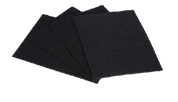
SPONGE Rubber Sheet
Secondly,in the automotive industry,sponge rubber sheet is often used as a sealant strip for car doors and windows and as a seat cushion material due to its high elasticity and wear resistance.

- Product Introduction
Crestmat is a leading rubber material and rubber product supplier in China. The factory has been devoted in special rubber compounding for more than 30 years. The products mainly include rubber materials like fluorosilicone (FVMQ), arylate rubber (ACM), Hydrogenated Nitrile (HNBR), fluoroelastomer (FKM) and rubber calendering products such as HNBR sheet, FKM sheet, fluorosilicone sheet and rubber extruded products such as fkm o ring cord, HNBR rubber cord, fkm profile and high quality ffkm oring. The products are widely used in aviation, automobile, petroleum, marine, semi-condutor and many other fields. The rubber compounding factory is well equiped with Japan-made banburies, two-roller mixers, reaction kettle, strainer; the rubber product factory is equiped with Rotocure machine, press machine, extruder. The lab is equiped with Rheometer, Hardness Testor, Elongation Testor, Rotary Viscosimeter, Biochemitry Incubator.
Why Choose Us
Advanced Equipment
The rubber compounding factory is well equiped with Japan-made banburies, two-roller mixers, reaction kettle, strainer; the rubber product factory is equiped with Rotocure machine, press machine, extruder.
Professional Team
FKM material is equiped with 3 production lines, one for precompounds, one for black compounds, one for colorful compounds. The maximum capacity for fluoroelastomer compound and polymer is 4800 tons per year.
High Quality
In our Reaserch and Development Certer, we have a leading laboratory equiped with a full sets of testing machinary. Here we can develop the new formulations and also test the rheological properties and physical properties for each batch of orders.
Customized services
The rubber compounding factory is well equiped with Japan-made banburies, two-roller mixers, reaction kettle, strainer; the rubber product factory is equiped with Rotocure machine, press machine, extruder. The lab is equiped with Rheometer, Hardness Testor, Elongation Testor, Rotary Viscosimeter, Biochemitry Incubator.

Silicone rubber sheets are widely used in high-tech fields such as aerospace, electronics, and medical equipment.

Nitrile rubber sheet has oil resistance, wear resistance, acid and alkali resistance, etc., and also has good weather resistance and corrosion resistance.

EPDM rubber sheet has excellent weather resistance, heat resistance and corrosion resistance, and also has good elasticity and mechanical strength.


Fluorine rubber sheet has excellent chemical resistance, high temperature resistance, oil resistance, acid and alkali resistance and oxidation resistance, and also has good mechanical strength and electrical insulation performance.

HNBR rubber sheet has good thermal stability, oil resistance, acid and alkali resistance and ozone resistance, and also has good mechanical strength and wear resistance.

Fluorosilicone rubber sheet is often used in applications where extreme temperatures, fuel, oil, and other chemicals have an effect as it is known to resist attack from these materials.

Sponge rubber sheets are commonly used in various applications such as sealing, heat insulation, sound insulation, shock absorption and gaskets. Its advantages include high compressive and elastic properties, excellent thermal insulation properties, good sound absorption properties, and excellent shock resistance.
What is SPONGE Rubber Sheet?
Sponge rubber sheet, also known as expanded foam rubber, is a versatile and resilient material that finds widespread use across various industries. Made from synthetic rubber and silicone compounds, sponge rubber sheet has an expanded cellular construction that is flexible and compressible. It is commonly manufactured with a closed-cell structure so does not absorb water and can be used to stop water ingress. Sponge seals manufactured from these materials demonstrate a level of durability that meets the demanding requirements of a diverse range of sealing applications. As well as being suitable for creating watertight seals, it can also be used for shock-absorbing and cushioning.
Benefits of Sponge Rubber Sheet
One of the key benefits of sponge rubber sheet is its ability to compress and fill irregular gaps. When positioned between two surfaces, sponge sections are fairly soft so easily squash to create seals that stop the ingress of water, dirt and air. A sponge seal should return to its original shape and dimensions once the compression has been removed. However, excessive compression may cause permanent deformation of the seal. This is known as compression set which refers to the deformation or loss of thickness experienced by a material that has been subjected to excess force over an extended period of time. Compression set can be avoided by adjusting the compression force so that the sponge section is compressed by approximately a third.
Sponge rubber sheet can be manufactured with either an open or closed-cell structure. Whilst both materials present a similar appearance, they have very different properties that make them suitable for different applications. Open-cell sponge is softer, permeable to water and has less resistance to compression. This is useful for applications such as absorbing and reducing sound, but has obvious limitations for creating reliable watertight seals.
The majority of products manufactured from closed-cell sponge rubber sheet materials are used as sealing solutions that aim to prevent water ingress. As closed-cell sponge is inherently resistant to the absorption of water and other fluids, it is suitable for outdoor sealing applications, as well as in environments where exposure to moisture is a concern.
The density and weight of sponge rubber sheet, whether in open-cell or closed-cell form, is lower than comparable materials, such as solid rubber, plastic and metal. The lightweight nature of sponge is advantageous in industries where weight is a critical factor. As most sponge seals are made from closed-cell materials, they are also buoyant and suitable for flotation devices or marine applications.
The cell structure of both foam rubber sheets and sponge rubber sheets consists of thousands upon thousands of interconnected, bubble-like cells formed by introducing gas or chemicals directly into a polymeric compound while in its liquid state. As the polymer cools and hardens, depending on the process, bubbles form into either open-cell or closed-cell units, meaning that the cells can either hold air or permit its passage.
More specifically, foam rubber is produced by dissolving a chemical or gas agent with a blowing agent to generate gas bubbles in a liquid polymer mixture. The liquid mixture for foam rubber includes liquid polymers (Polyols, Polyisocyanates), water, and colorants. The composition of the liquid polymers and the type of gases determines how flexible or rigid the foam rubber will be. Carbon dioxide gas is used to make the foam flexible, whereas hydrofluorocarbons (HFCs) and hydrochlorofluorocarbons (HCFCs) gases are used to form a more rigid foam rubber. Foam materials are manufactured from polymers such as polyurethane, polyethylene, EPDM rubber, silicone, PVC/Nitrile, Neoprene sheet, and acrylic, among others.
Sponge rubbers, in general, are made with such elastomeric compounds as silicone, neoprene, EPDM, nitrile, and other materials. Like foam rubber, the cellular structure of sponge rubber contains interconnected, bubble-like cells that are either open-cell or closed-cell. Open-cell material allows air, water, and other chemicals to pass through. The open cell structure is formed by adding sodium bicarbonate into a heated mold with other ingredients. The reaction creates bubbles and releases carbon dioxide gas, causing the material to expand and create voids, resulting in a sponge-like material substance with a porous structure. Elastomers used for open-cell sponge profiles include polyurethane, polyester, and polyether.
Closed-cell sponge rubber does not allow the passage of gas or liquid, which, consequently, makes the material denser. The closed cells are formed by adding a chemical powder that decomposes when heated, producing nitrogen gas that fills the cells and gives the material the needed strength and density. Sponge rubber can be manufactured with different densities, from soft to medium or firm. The range of elastomeric compounds for closed-cell sponge rubber includes EPT, EVA, nitrile rubber, silicone, Neoprene, EPDM, PVC sponge, and SBR sponge. Polyethylene and polyurethane are also used in applications.
Type of SPONGE Rubber Sheet
Nitrile Rubber Sheet
Nitrile rubber sheet is a synthetic rubber compound recognized for its exceptional resistance to oils and fuels, widely used in environments where exposure to petroleum-based substances is a significant concern. Possessing excellent resistance to oils and fuels, nitrile is a preferred choice in environments with inevitable contact with petroleum-based substances.
01
EPDM Rubber Sheet
Ethylene Propylene Diene Monomer (EPDM) rubber sheet is a resilient rubber renowned for its excellent resistance to weathering, ozone, and UV exposure. Ideal for roofing membranes, outdoor seals, and water-related applications, EPDM ensures durability in diverse environmental conditions.
02
Silicone Rubber Sheet
Silicone rubber sheets are highly regarded for their versatility and unique properties, exhibiting excellent flexibility, resilience, and temperature resistance. Notably, silicone rubber is commonly FDA approved, making it a trusted material for applications in the food and medical industries.
03
Natural Rubber Sheet
The flexibility and temperature resistance of silicone make it suitable for a wide range of applications. Its FDA approval underscores its safety for use in food-grade and medical applications. Silicone rubber maintains its properties across a broad temperature range, ensuring stability in diverse environments.
04
Fluorosilicone Rubber Sheet
Fluorosilicone rubber sheets stand out for their exceptional performance, particularly in challenging conditions. They excel at extreme low temperatures, outperforming many other rubber varieties, and exhibit superior resistance to volatile fuels, oils, and petroleum chemicals.
05
The application of sponge rubber sheet is extensive and it is widely used in many industries.
Firstly,in the building decoration industry,sponge rubber sheet is often used as a decorative material for floors,walls,and ceilings due to its good sound insulation,heat insulation,and waterproofing properties.
Secondly,in the automotive industry,sponge rubber sheet is often used as a sealant strip for car doors and windows and as a seat cushion material due to its high elasticity and wear resistance.
Thirdly,in sports equipment,such as yoga mats and running machine belts,sponge rubber sheet is often used as raw material.
Although sponge rubber sheet has many advantages,there are still some problems in its actual application.For example,due to its soft material,it is easily compressed and worn by external forces,causing its shape and size to change.
Firstly,we can enhance the strength and wear resistance of sponge rubber board by improving production processes,making it better suited to various complex application environments.
Secondly,we can add flame retardants to sponge rubber board to improve its fire resistance and ensure its safe use in fires.
Moreover,we can fully utilize the advantages of sponge rubber board by optimizing design and construction methods,and avoiding the negative impact of its disadvantages on construction projects.

What is the Difference Between Sponge Rubber and Foam Rubber?
It can be quite hard to discern the difference between sponge rubber and foam rubber when it comes to the average consumer. That's because both terms are often used interchangeably, but their applications are quite different considering their molecular build and benefits to the user.
Foam rubber is an air-filled structure and is generally made of Polyurethane or Latex (PVC). As its cells are structurally rigid, it performs exceptionally well as a sound and/or physical impact dampener. That's why one of its main uses is the manufacture of mattresses, as foam rubber is well known for its durability, ageing and endurance. It's also lightweight, has excellent cushioning performance and it's buoyant.
Other common applications are glass protection and shipping pads, sun visors, appliance seals and gaskets, and light and dust seals for the home.
There are two main types of sponge rubber that are commonly known as closed cell and open cell, and are most commonly produced from polyethylene foam.
Closed cell sponge rubber doesn't allow the passage of water, air, dust, and other chemicals through its isolated, closed pockets. It has excellent resistance to UV and due to its closed cell properties, it's a brilliant candidate for outdoor applications in both hot and cold environments. It's also exceptionally durable which means it ages well, and it doesn't really degrade over time.
It works incredibly well as a gap filler, as it both insulator and prevents the absorption of water. Not to mention its capabilities in noise and vibration dampening and its use for cushioning. Closed cell polyethylene is often used within the Aviation and Aerospace industry for aircraft seating due to its durability, comfort and lightweight properties.
Open cell sponge rubber or foam is more commonly used in the day-to-day applications that we use as consumers. Open cell has open, interconnected pockets that allow for the passage of water, air, and other chemicals when the sponge rubber hasn't been compressed. That means open cell sponge rubber is typically used in applications where such elements need to be absorbed.
Open cell sponge rubber soaks up liquid and then traps it until compressed. Consider its use in general purpose sponges, sponge cloths, kitchen towel, cosmetic foundation applicators, aquatic filtration, etc.
The process of manufacturing expanded SPONGE Rubber Sheet products involves adding additives, such as curing agents and accelerators, to the raw rubber compound. The combined mixture is then mechanically whipped which helps evenly distribute the foaming agent throughout the compound. These foaming agents release gas when heated which generates bubbles in the material. This process creates a cellular structure within the rubber, resulting in a closed-cell spongy texture. The exact manufacturing steps may slightly vary depending on the specific type of rubber material and its intended application.
This SPONGE Rubber Sheet compound can be used to create extruded profiles, gaskets or flat sheets. Extruded sponge seals are manufactured by pushing the chosen rubber compound through an extrusion tool (known as a die). This process is completed using an industrial extruder which uses pressure and temperature to extrude the required shape. The heat during this procedure causes the foaming agents to release gases and creates a closed-cell cellular structure within the rubber. Sponge seals manufactured using this method have a smooth glossy skin so can be used for applications where the product will be visible.
SPONGE Rubber Sheet can also be supplied in cut lengths. This process starts by pouring the chosen rubber compound into a large rectangular tank, usually 2 metres wide by 1 metre long. This creates a large block of rubber that can be horizontally sliced to the required thickness. These rectangular sheets are then vulcansed end-to-end to create a 6 metre long length which is carefully rolled into a 'log' and cut using a cutting machine to the required width.
It is possible to apply an adhesive backing to most sponge seals and strip during the manufacturing process.
Our Factory
Crestmat is a leading high performance rubber material and rubber product supplier in China. The factory has been devoted in special rubber compounding for more than 30 years.


FAQ
Hot Tags: sponge rubber sheet, China sponge rubber sheet manufacturers, suppliers, factory, rubber sheet, SBR Rubber Sheet, SPONGE Rubber Sheet, EPDM Rubber Sheet, Silicone Rubber Sheet, FKM Rubber Sheet